
Titas Chanda
Assistant Professor
Department of Physics
IIT Madras
Chennai, India
Hello there…
I am Titas Chanda, a theoretical physicist working as an Assistant Professor in the Department of Physics at the Indian Institute of Technology Madras (IIT Madras), where I lead the Synthetic Quantum Systems (SQS) research group. I am also affiliated with the Center for Quantum Information Communication and Computing (CQuICC), IIT Madras.
My research broadly spans condensed matter theory, quantum many-body physics, quantum information science, and quantum simulation. I am particularly interested in uncovering the fundamental principles that govern complex quantum systems through a combination of analytical and numerical approaches.
My current interests include strongly correlated quantum systems, tensor network methods, critical phenomena, lattice gauge theories, topological phases of matter, out-of-equilibrium dynamics, and more. These topics are investigated in a variety of physical settings, including ultracold atoms in optical lattices, Rydberg atom arrays, trapped ions, cavity QED setups, and other emerging synthetic quantum systems.
More details about my research can be found on the Research page.
Recent News
26 August 2026
Sourabh’s first paper is on arXiv. And by coincidence, it happens to be my 50th arXiv entry. Link: https://arxiv.org/abs/2608.24248.
The physics: The (free fermionic) cluster Ising chain has a critical point described by an SU(2) level-2 Wess-Zumino-Novikov-Witten theory with a triplet of Majorana fermions having exact O(3) symmetry. Adding an interaction reduces this O(3) to its cyclic subgroup \(C_3\), splitting the triplet into a singlet and a doublet whose gaps close separately, producing a critical bifurcation into two critical lines. One of them separates two ferromagnets that Landau theory says cannot be connected by a continuous transition – a deconfined critical line, and it sits in the eight-vertex universality class.
July 2026

June 2026
Welcome to my new website! This site replaces my previous Google Sites page. The new platform offers greater flexibility and will be regularly updated with research updates, publications, teaching materials, and other relevant news.
April 2026
January 2026
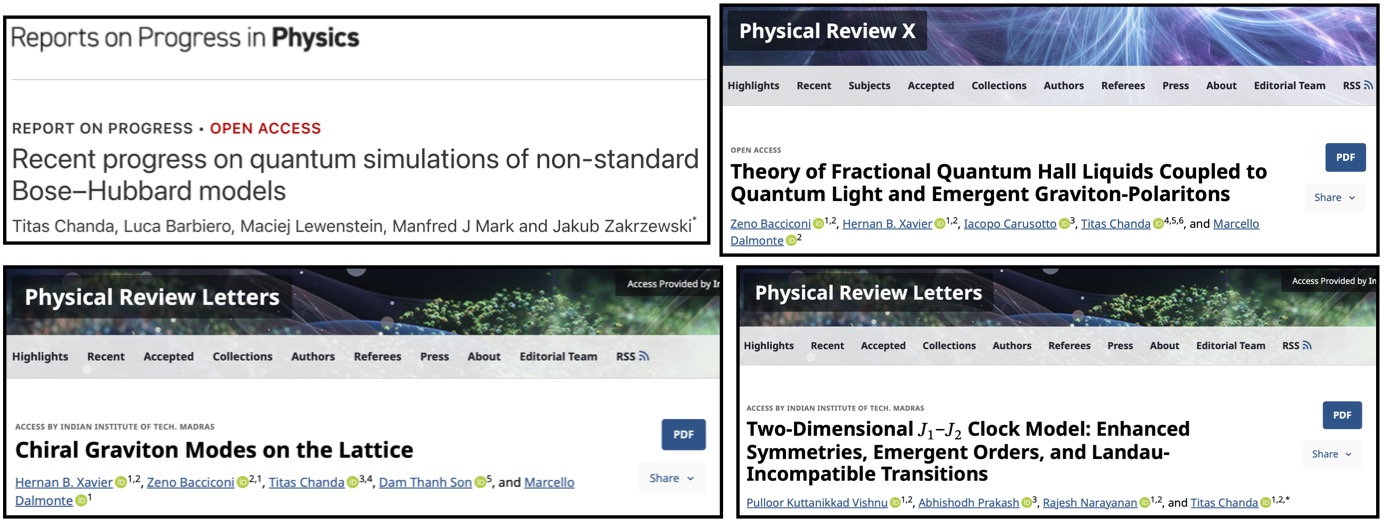
- A review article in Reports on Progress in Physics surveyed recent theoretical and experimental advances in non-standard Bose–Hubbard models, with a particular emphasis on long-range interactions and quantum simulation with ultracold atoms.
- A Physical Review X paper developed a theoretical framework for fractional quantum Hall states coupled to quantum light, revealing cavity-induced topological phenomena, including graviton-polaritons and light-matter entanglement.
- A Physical Review Letters paper demonstrated that chiral graviton modes survive in lattice fractional quantum Hall systems, providing a realistic route for their observation in quantum simulation experiments.
- Another Physical Review Letters paper uncovered emergent phases and unconventional critical phenomena in frustrated clock models, revealing a novel mechanism for the emergence of forbidden discrete symmetries at long wavelengths.